

Wednesday, April 30, 2008
2008 Clarke Award Winner
It has been announced that Richard K. Morgan's novel Black Man/Thirteen (UK title/American title) is the winner of the 2008 Arthur C. Clarke Award. This award, originally funded by Clarke himself with the intention of popularizing science fiction in the UK, serves as a means of selecting the best novel in the genre released in Britain during the previous year. More information on the award and past winners can be found on the official home page.


What to read next?
I'm having a problem deciding what to read after I finish my current book so I added another poll for which book to read and review next. Plus seeing what people choose is fun!
There are 5 fantasy books to choose from since I've been on a science fiction kick lately and I don't want to annoy you all by reading too many non-fantasy books on a book review blog that claims to be about fantasy.
The options are:
Before They Are Hanged by Joe Abercrombie (#2 First Law Trilogy)
Blood and Iron by Elizabeth Bear (#1 Promethean Age)
Calenture by Storm Constantine (stand alone)
Hood by Stephen Lawhead (#1 King Raven)
The Well of Ascension by Brandon Sanderson (#2 Mistborn)
There are 5 fantasy books to choose from since I've been on a science fiction kick lately and I don't want to annoy you all by reading too many non-fantasy books on a book review blog that claims to be about fantasy.
The options are:
Before They Are Hanged by Joe Abercrombie (#2 First Law Trilogy)
Blood and Iron by Elizabeth Bear (#1 Promethean Age)
Calenture by Storm Constantine (stand alone)
Hood by Stephen Lawhead (#1 King Raven)
The Well of Ascension by Brandon Sanderson (#2 Mistborn)
Monday, April 28, 2008
Guest Review of God's Demon
 |  | |
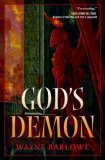 God's Demon by Wayne Barlowe 352pp (Hardcover) My Rating: 7/10 Amazon Rating: 4.5/5 LibraryThing Rating: 4/5 Goodreads Rating: 3.57/5 |  | |
 |

Following his Fall from grace Sargatanas's former status as a seraph granted him the station of Demon Major in Hell, a sort of feudal lord of the damned. He spent millenia carrying out the divine instructions that demons, sent to Hell as punishment, were to in turn punish the lesser human souls who followed. But Sargatanas never had the enthusiasm that many of his kind showed for torture. Rather than embrace his new position, he recognized how wrong he was in rebelling against God and sought to return to Heaven.
This desire was far from unique, but instead of allowing his loss and frustration to become bitterness and hatred Sargatanas tried to create as much Heaven as is possible while living in Hell. His city, Adamantinarx-Upon-the-Acheron, is modeled after the cities of Heaven. Over time, he even begins to feel sympathy for some of the souls under his command--though it doesn't keep him from treating them as literal resources to be consumed in the construction of his city, which is built of human souls compressed into infernal bricks. When he meets a soul who asks why she was condemned to Hell because she killed in a just war "against a ruler who neither understood nor cared for me" these feelings come to a head and Sargatanas decides he will either return to Heaven or be destroyed in the attempt.
So begins Sargatanas's war of rebellion against Beelzebub, regent prince of Hell, and the all the demonic legions, dead demi-gods, and soul-constructed war machines he commands.
Remember Dante's Inferno? Wayne Barlowe clearly does. Though the view of Hell that he puts forth in God's Demon is very different from Dante Alighieri's, Barlowe's scope and detail of description certainly bring to mind the seven hundred year old poem. Hell is not a setting in this book; it is an environment, and it just happens to have a story taking place in which the reader might be interested if they have a moment to spare. Peter Jackson's fascination with New Zealand has nothing on Barlowe's fixation on Hell. Appropriately for Barlowe, who is mostly known as an artist, this book is like reading a painting...certainly not a pleasant painting, but one that is incredibly vivid and detailed. Some of the very lengthy descriptions would make anyone from Hieronymus Bosch to Dave McKean squirm in their chair.
But while the environment of Hell shows a great deal of thought and planning, the actual story being told leaves something to be desired. And that is an intentional phrasing; the book is not bad or poorly written, but a background and plot of this scale demand more depth than Barlowe has created. Former angels, condemned to an eternity in Hell for taking part in Lucifer's rebellion but now focused on returning to Heaven should have a myriad of internal conflicts. A feudal political structure thousands of years old give birth to shifting alliances, loyalties, and betrayals. Even the demons themselves are disappointing as their power plays are almost entirely based on straight-forward physical or magical power, only rarely displaying the cunning or deception one would expect from, well, a demon.
The overall plot and construction of the story shows a similar lack of depth. Sargatanas starts his war because he wants to return to Heaven, but he never really gives an explanation for how he expects the war to accomplish this goal. A key subplot, Hannibal Barca's attempt to lead the human souls as warriors in Sargatanas's army (think Lincoln allowing ex-slaves into the North's army during the civil war) never really comes together despite a promising start. Even the main plot is extremely linear, without the sort of diversions that appear when characters are trying to find their way through a difficult situation; the characters all know exactly what they want, can think of one way to get it, and will try as hard as they can to make it happen. Luckily, the plot is only about 40% of the book, and the 60% that is lush description distracts you in the same way that outstanding CGI can prop up a summer blockbuster. You won't realize how little actual story there is until you've finished the book, and that makes God's Demon a good read despite a lingering feeling of missed potential.
Rating: 7/10
Other opinions:
Sunday, April 27, 2008
Review of Cordelia's Honor
| | |
  Cordelia's Honor by Lois McMaster Bujold  608pp (Paperback) My Rating: 8/10 Amazon Rating: 4.5/5 LibraryThing Rating: 4.37/5 Good Reads Rating: 4.26/5 | | |
|
Cordelia's Honor contains the first two chronological novels in Lois McMaster Bujold's Miles Vorkosigan series, Shards of Honor and Barrayar. These books could also be viewed as prequels to the series since they are not actually about the life of Miles but instead tell the story of how his parents met and how Miles came to be disfigured before birth. Shards of Honor is Bujold's first published novel while Barrayar was released 5 years later after other books in the series had been written. The latter is a direct sequel to the former and completes the story begun in the first book, some parts of which Bujold had originally wanted to include in Shards of Honor before she realized it was too long. While the first half of the story was certainly enjoyable, it did lack polish and Bujold's extra writing experience shows in Barrayar, which is a much tighter novel and the winner of the 1992 Hugo Award.
In Shards of Honor, Commander Cordelia Naismith from Beta is part of an astronomical survey expedition until she and her crew are disrupted by a military force of their enemies from Barrayar, who claim they found the planet first and insist the Betans surrender to them. Most of Cordelia's party escapes, leaving her and her botanist, whose mind was destroyed by a disruptor fired by one of their foes, stranded. The commander meets and is taken prisoner by Captain Aral Vorkosigan, infamous as the "Butcher of Komarr." This knowledge does not stop Cordelia from being openly hostile to Vorkosigan, but soon she begins to see that he is an honorable man even if his society's beliefs are very different from her own.
Barrayar continues shortly after the marriage of Cordelia and Aral and Aral's appointment to the position of Regent of Barrayar. Cordelia's former expectations of a quiet life with her new husband are turned upside down as their lives become more dangerous due to conspiracies to take the throne. Aral is already unpopular with many on this very harsh, political world due to his liberal views, and now he is a very clear target for those who desire to replace the regent and the five year old emperor.
The slower-paced Shards of Honor contains romance, adventure, an exploration of the concepts of duty and honor, and an illustration of the cruel Barrayarans and the compassionate but misguided Betans. The science fiction elements are in the background - although the story takes place in a world where space travel occurs, technobabble and heavy-handed scientific explanations are not present. The characters of Cordelia and Aral are likable with a dry humor that emerges at times and personalities that are clear from their words and actions. It was not always a tight story and the aftermath chapter at the end in particular seemed to come from out of nowhere and not tie in to the rest of the tale, but it was an entertaining book that made me eager to read more.
Barrayar is much more tightly plotted and faster paced than its predecessor with adventure and political scheming galore. The headstrong, independent Cordelia is still a pleasure to read about. The characters besides her and Aral are also better written and there are new ones introduced as the heroine settles into life on Barrayar. This also allows the society to be examined more as well as the political division between people like Aral who believe change is necessary and those like his father who are set in the old ways and abhor the idea of changing them. In the afterward, Bujold states that the book is "about the price of becoming a parent," but the theme that stood out for me was that people often viewed as being without worth by others, like the crippled Koudelka and disfigured child Miles, were still human and could be perfectly useful and valuable in spite of their shortcomings.
Cordelia's Honor comprises two novels of varying quality and complexity but both of these have one thing in common - they are worth reading for interesting characters and entertainment.
8/10
Nebula Award Winners Announced
This year's Nebula Award winners have been announced on the Science Fiction Awards Watch Blog. The following is a list of the winners:
- Novel: The Yiddish Policemen’s Union - Michael Chabon (HarperCollins, May07)
- Novella: “Fountain of Age” - Nancy Kress (Asimov’s, Jul07)
- Novelette: “The Merchant and the Alchemist’s Gate” - Ted Chiang (F&SF, Sep07)
- Short Story: “Always” - Karen Joy Fowler (Asimov’s, Apr/May07)
- Script: Pan’s Labyrinth - Guillermo del Toro (Time/Warner, Jan07)
- Andre Norton Award for Young Adult Science Fiction and Fantasy: Harry Potter and the Deathly Hallows - J. K. Rowling (Scholastic Press, Jul07)
Tuesday, April 22, 2008
Guest Shameless Retroreview Plug: The Beggars Trilogy
 Nancy Kress's Beggars Trilogy (Beggars in Spain, Beggars and Choosers, and Beggars Ride) is an exploration of the world she created in her Hugo and Nebula Award winning novella, also called Beggars in Spain. All three books are among my favorite reads of all time, full of interesting ideas and unique characters, but I don't believe they always get the recognition they deserve in the science fiction community. This trilogy follows the path of a near-future United States--and by extension, the rest of the world--as it deals with the economic, social, and philosophical upheaval brought on by advancing technology. Kress's understanding of human gifts and frailties, both as individuals and communities, results in a view that is simultaneously frightening and hopeful; perhaps that is why I find the course they plot so plausible. I highly recommend that any fan of science fiction, or even simple student of the human condition, read these amazing stories.
 Nancy Kress's Beggars Trilogy (
Beggars in Spain follows the life of Leisha Camden, one of the first of a literal new breed of humanity. As the favored daughter of a powerful data industrialist she is given every possible advantage, which in this world includes in utero genetic engineering. This includes exceptional physical appearance and intelligence, freedom from any genetic defects, and even a newly developed modification: the ability to live without sleeping. Because Leisha's father begrudges his body the few hours a night it demands from him, he ensures that his daughter will never have to give in to such a fundamental frailty.
As Leisha grows into a young woman, though, the doctors and geneticists tracking the development of her and the other Sleepless discover that the effects of their tinkering reach far beyond their intent. The biological advantages these children were granted are so great that they stretch the definition of human--or at least, the limits of what unmodified society is willing to accept as human. In a capitalist society that is predicated on the notion of competition driving advancement, the Sleepless are simply so much better at competing that their only real competition is among themselves. And, as with other times in human history when great economic power is held by those without the political or physical power to hold it, lawful competition must eventually be set aside in favor of a more effective means of redistributing wealth.
These big social concepts are almost entirely explored through Leisha's relationships with the people around her. Most important is the strained bond between her and her unmodified fraternal twin sister, Alice. Alice is, both by biological reality and conscious choice, everything Leisha is not, and she provides a proxy through which we can see how Sleepers deal with their new reality as an inherently inferior race. Alice's counterpart among the Sleepless is Jennifer Sharifi, as intentionally inhuman as Alice is human, and a leading voice in Sleepless internal politics. The other loves, rivals, and simple acquaintances in Leisha's life all play a role in shaping her personal philosophy and vision of how to bring together a society that is dangerously, perhaps irreparably, fractured. Finally, to close the circle, a new generation of SuperSleepless are developed that are as far beyond the Sleepless as the Sleepless are beyond the Sleepers. 10/10
(The following two books will be discussed in less detail to try to minimize spoilers, but some may still slip through.)
 Beggars and Choosers is the follow-up to Beggars in Spain, and in my opinion is the weakest book of the trilogy due to some pacing issues. Sleeper and Sleepless society has entered into an uneasy truce, though as with most truces it is largely an excuse to prepare for the next battle.
In the meantime, however, life goes on for the unmodified humans that no longer live on Earth so much as inhabit it. Beggars and Choosers tells the story of the Livers and their Donkeys, the regular people who have been made economically obsolete and the upper class that controls society and 'works' for the Livers by providing them the food, shelter, and leadership they need. Most of the book deals with these lower classes trying to discover the machinations of the elite Sleepless and almost godlike SuperSleepless by following Diana Covington, an agent of the Donkey government, as she infiltrates a Liver community. This particular group of Livers has a story about a magical place they call Eden which Diana believes is a key to unraveling the wheels-within-wheels plans of the Supers.
A key parallel plotline is narrated by Drew Arlen, Leisha's adopted son. He is, if anything, even more human than Leisha's sister Alice, physically and emotionally crippled but possessing a talent for creating holographic stories that touch their viewers at a subconscious level. Arlen's self-pitying attitude is put to the test when he meets a group of humans who, though they are not disabled as he is, face even bigger challenges because they are social and economic outcasts in the Sleepless-dominated society. Rating: 8.5/10
 Beggars Ride shows the final outcome of the social transformation begun in the first two books and returns to the outstanding quality of Beggars in Spain. The truce that held in Choosers is very definitively over and the subsequent conflict can only be resolved by changing the way in which both Sleeper and Sleepless society functions, and the only guidepost available for mapping out the future of human civilization is that what we've done in the past can no longer work. Rating: 10/10

Sunday, April 20, 2008
Review of The Mirador
| | |
  The Mirador by Sarah Monette 432pp (Hardcover) My Rating: 9/10 Amazon Rating: 4.5/5 LibraryThing Rating: 4.22/5 Good Reads Rating: 3.92/5 | | |
|
To my great chagrin, The Mirador, the third book in Sarah Monette's The Doctrine of Labyrinth series, is the last book in the series currently available. The fourth and final book Corambis has a projected publication date of sometime in 2009. The first two books in the series wrapped up a complete story arc and this novel takes place approximately two years after the end of The Virtu. While this book is slower-paced than either of its predecessors, it is a very enjoyable followup to the first two books.
Mildmay has been involved with Mehitabel Parr, who is now an actress in Melusine. One night after a performance, Mehitabel is visited by a man from her past who blackmails her into spying for the Bastion, an enemy of the Mirador. Afterwards, Mehitabel takes out her rage on Mildmay when he comes to see her, letting it slip that sometimes he confuses her with his long-dead girlfriend Ginevra. This causes Mildmay to return to the Lower City against Felix's will to seek the truth about who leaked the information that got Ginevra killed. Meanwhile Felix and Gideon are still together in a rocky relationship and a lot of angst ensues.
There was less plot advancement in The Mirador than the first two books in the series with even more focus on internal conflicts than the previous books, but it was still so absorbing that I did not even notice until I tried to write a plot summary in my head. A lot happened at the end giving it that "middle book" feeling in which it is largely setting up the next book. The end was filled with tension, dark and disturbing, and has the most shocking conclusion of any of the three books.
Mehitabel joins Felix and Mildmay as a point of view character. I would have preferred if the whole story had been told from the perspectives of the ex-thief/assassin and his wizard half-brother. Mehitabel's character played the role of the observer for the most part and she simply didn't hold my interest as a person - she was too well-grounded for a story that is largely appealing for the conflicted and troubled people. There were some advantages to reading from her perspective, however. It was at times interesting to see Felix and/or Mildmay through someone else's eyes and Mehitabel did become entangled in some court intrigue that allowed us to see glimpses of Shannon and the Lord Protector in a new light. Although the main characters in this series are exceptionally well-written, all the minor characters have always been rather flat and Mehitabel's viewpoint did show them with more depth than the previous installments.
In spite of these insights into some of the minor characters, I would trade them for more of the main two characters any day, particularly since there was not enough Felix in this book. Most of the book alternated between Mildmay and Mehitabel. While I love reading anything about Mildmay and thought Monette did a fantastic job of developing him further in this book, I find Felix's character fascinating and really missed reading about him as much as in the first two books. He is not the nicest character even though he is not intentionally spiteful, but he is so tormented and intriguing.
Another aspect of this book that was a little disappointing was that Felix and Mildmay spent so little time together in it. The two brothers largely avoided each other and became involved in their own side stories. I was going to say that their relationship was not explored in this book, but I changed my mind since it certainly was developing their connection and in character for both of them. Neither of them likes to talk about anything with great meaning and are private people when it comes to their inner thoughts; the two are so different yet in many ways so similar. It makes perfect sense that the close link of the obligation dame would drive them even further apart eventually. It was still frustrating to see them both so distant still after two years, but the fact that it is so upsetting just shows that Monette is a masterful writer to make you care about what happens to these people so much.
In spite of a few quibbles, I very much enjoyed this novel and found it difficult to put down, although it did not enchant me as much as The Virtu. Those who enjoyed the atmosphere and world-building aspects of the earlier books more than the characterization may be disappointed, as well as the few Felix fans who exist. Yet the resolution shows definite promise for a return to the elements that made the former book a personal favorite and I eagerly await the release of the next installment in what is now one of my favorite series of all time.
9/10
Read the first chapter on Sarah Monette's website. The first four chapters of The Mirador are available, as well as the first four of The Virtu.
Subscribe to:
Posts (Atom)


