Showing posts with label C.S. Friedman. Show all posts

Saturday, April 18, 2009

Review of Feast of Souls

Feast of Souls is the first book in the Magister trilogy, the latest series by C.S. Friedman, perhaps best known for her Coldfire trilogy. The second book, Wings of Wrath, was just released in hardcover in February. It has yet to be announced when the final book Legacy of Kings will be available. After reading C.S. Friedman's debut novel, the space opera In Conquest Born, I knew I had to read more of her work and after all I had heard about this one, it sounded right up my alley. Feast of Souls is a dark epic fantasy containing a wide cast of characters and many elements that are somewhat familiar to readers of the genre, yet they are well executed and the nature of magic in the world is interesting enough to keep it from feeling stale.

In Feast of Souls, magic requires great sacrifice, for those who practice it can only do so at the cost of shortening their own life. Small spells may only shave a few seconds or minutes from their time remaining but larger ones could remove a few years from the caster's total lifespan. The prologue introduces us to Imnea, a witch in her mid-thirties who feels about eighty years old due to the amount of magic she has used. Although she has retired from spellcasting to preserve what little time she has left, the people she helped throughout the years despise her for her selfishness in refusing to give up the last little bit of life she has left to help them. When a woman comes to Imnea requesting she save her child from a plague, Imnea resists at first but ends up giving up her life to help the boy. Meanwhile, his young sister Kamala watches and determines to become the first female magister rather than die from using her ability.

The magisters are a small group of men who can wield magic to their heart's content without dying. Many of them have survived for centuries despite rather liberal use of their power. Their secret of longevity is only known to themselves and no woman has ever been able to accept the consequences of becoming a magister, for the cost of magic is still life itself and magisters simply use another person to fuel their spells. When the Prince Andovan is diagnosed with the Wasting disease associated with those who are bound to a magister, their ugly secret is threatened - a truth that must remain hidden from the general public so the vulnerabilities of the magisters is not exposed.


This book was a little difficult to get into toward the beginning, as it switched back and forth between characters and introduced the main players and their motivations. However, once the story got going, it was difficult to put down and I ended up staying up late one night to finish it because I just had to know how it ended as soon as possible. The story is far from finished, though, with many questions left unanswered in the first installment of this trilogy.

Overall, there were many plot elements and character descriptions that seemed like very typical fantasy tropes. An old, nearly forgotten threat to the world returns true to the prophecy that what had happened before would happen again. Most people regarded this danger as an old myth but a few chosen to defend remember it. There is a mad king (both crazy-mad and temperamental-mad) who is led astray by a corrupt adviser. A mysterious wizard seems to know more about events than he is willing to share. These are still handled well, but there are two main parts that make a Feast of Souls stand out from the typical fantasy novel: the examination of power via effects of wielding magic and Kamala.

C.S. Friedman's portrayal of power is harsh. It's fleeting for those who are not cold enough to use the energy of other people. The only way to remain strong is to be a survivor, to be willing to look out for yourself first and remain alive no matter what the consequences - even if it means that somewhere an innocent person dies to keep you hale. Although the means of becoming a magister is horrible, they do some good. Power is not always exercised for selfish reasons - one may use the life force of a single person to save several people.

Most of the characters did not seem particularly well developed or out of the ordinary to me in this largely plot-driven novel - the one big exception to this was Kamala. From early on, the one character whose story always hooked me and kept me reading was Kamala's. The powerful scene in the prologue showed a defining moment in shaping her life and from then on I was very intrigued by the young woman who had the strength and determination to pursue a path knowing that all others of her gender had not been able to follow it. She has not had a happy life (her mother was poor and sold Kamala to men as a prostitute at a young age) but has come out more resilient instead of weakened. Kamala is not a "good" character but she is not come across as an "evil" person, either. It is perfectly reasonable that she would be hardened, but she is not completely heartless.

Feast of Souls is the beginning of what promises to be an entertaining dark fantasy series. Although it has some obvious characteristics of the genre, there are enough elements done well that it's well worth the read and I'm looking forward to the next book (although I will be waiting for it to come to paperback).

8/10

Read the prologue (scroll down)

Other Reviews:

Saturday, December 29, 2007

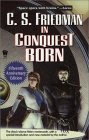
Review of In Conquest Born


In Conquest Born, published in 1986, is the first published novel by C.S. Friedman, who is now known primarily as the author of the Coldfire trilogy. This space opera was originally written as a stand-alone novel, but a sequel called The Wilding was released in 2004. The second novel takes place approximately 200 years after the events of In Conquest Born and features completely different characters so it sounds as though you do not have to read it in order to finish the story - only if you are curious about what happened to the various races of people as a whole.

The Azeans and the Braxins are involved in a never-ending war against each other. Faced with the need to adjust to life on a harsh planet, the Azeans have used genetic engineering to alter themselves accordingly and have embraced and strengthened the telepathic ability belonging to some of their kind. The Braxins have bred a race of leaders known as the Braxana, who are ruthless and untrustworthy. The Braxana have been known to break peace treaties between the two peoples and plot against their own families in order to seize power.

All Azeans have been altered to have golden skin and white hair, so when Anzha, a girl with blood red hair, is born to an Azean family, she is immediately made an outcast and denied citizenship. After watching her parents die a slow and agonizing death due to a Braxana, Anzha's amazingly strong telepathic abilities are discovered. The Institute, the center of knowledge dedicated to teaching telepaths and researching these abilities, takes Anzha under its wing and attempts to manipulate her. Anzha only has one drive in life - taking revenge on the Braxana who murdered her parents. Thus the vendetta between Anzha and the Braxana Zatar begins.


Although there are some physical battles in this book, the plot largely focuses on political manipulation and enemies attempting to out-maneuver one another. The intelligence of the characters was refreshing and I felt that Friedman pulled this off very well. Many books that attempt to show devious people outsmarting others end up making the characters look stupid since you can see very big, obvious errors in their reasoning. This book actually made the characters look like they had brains, and I enjoyed seeing how the schemes played out.

The various races in this book were well-developed with distinct histories and beliefs. The values of the Azeans and the Braxins were so different that you could see why they continue to be at war with each other, even if the cause was long-forgotten.

Characters in this book were not black or white but gray, and I always appreciate an author who can pull off the feat of characters who are not clearly good or evil. The Azeans and Braxins both had their dark sides, yet their main representatives in the book (Anzha and Zatar) were not so despicable that you could never feel sympathy for them. I found both to be enjoyable characters, especially if you're not in the mood to read about perfectly nice goody-two-shoes-type characters.

Although I really enjoyed this story, the politics, the characters, and the portrayal of the various races, In Conquest Born is not flawless. The beginning was slow, making the story difficult to get involved in, and at times events were a little confusing. The prose was decent enough, but the story did not always flow very well as it jumped from character to character. Sometimes it switched from third person to first person from the perspective of a character who had not been mentioned previously (and was never a point of view character again), which could be rather jarring. Also, a rather large number of typos prevented me from getting lost in the story as well as I could have.

In Conquest Born contains many ingredients for an intelligent, well-plotted novel with interesting characters and diverse races; however, it fails to mix them in a way that creates a connected story. In spite of that, I do believe it is compelling enough to make it well worth reading.

7.5/10